
Welcome to the Official CIS Cathpro Indonesia
Optimizing Pipeline Performance Through Comprehensive Inspection
 What is Close Interval Survey (CIS)?
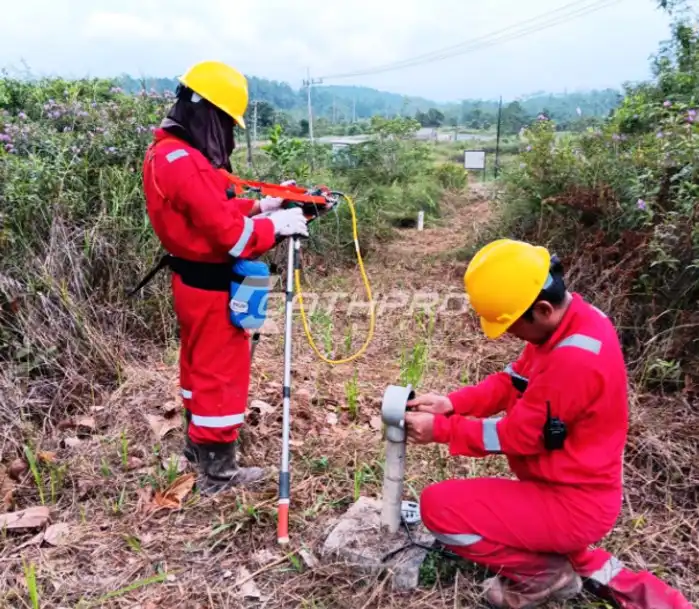 What is Close Interval Survey (CIS)?
Close Interval Survey (CIS) is an in-depth inspection method to ensure the integrity and safety of pipeline systems. Utilizing state-of-the-art technology, CIS helps detect potential issues and prevent leaks or pipeline failures. A close interval survey (CIS) is a measurement tool used to ensure pipeline cathodic protection systems are operating to NACE SP0169 specified standards.
The Close Interval Potential Survey (CIPS) is a method used to monitor and measure the electrochemical potential on underground pipes to detect and control corrosion. Here are the simplified steps in how CIPS works:
- Selection of Reference Electrode: In the initial stage, a reference electrode is chosen and placed on the ground surface near the pipe being observed.
- Power Supply Setup: An external power source, typically from a DC battery, is connected to the pipe under test and the reference electrode.
- Reading Pipe Potential: Through the reference electrode, the electrochemical potential of the pipe is measured and recorded at regular intervals. Recordings are made to create a map of the pipe potential.
- Movement of Reference Electrode: The process is repeated by moving the reference electrode at specified intervals along the pipe, covering the entire length of the pipe under examination.
- Data Analysis: The collected potential data is analyzed to identify potential corrosion issues. Significant variations in potential can indicate areas vulnerable to corrosion.
- Corrective Actions: If potential issues are detected, corrective measures can be taken to stop or prevent corrosion, such as cathodic protection or repairing pipe coatings.
The CIPS method helps pipeline operators regularly monitor the electrochemical potential of pipes, allowing for early detection of corrosion issues and taking preventive action before serious damage occurs.
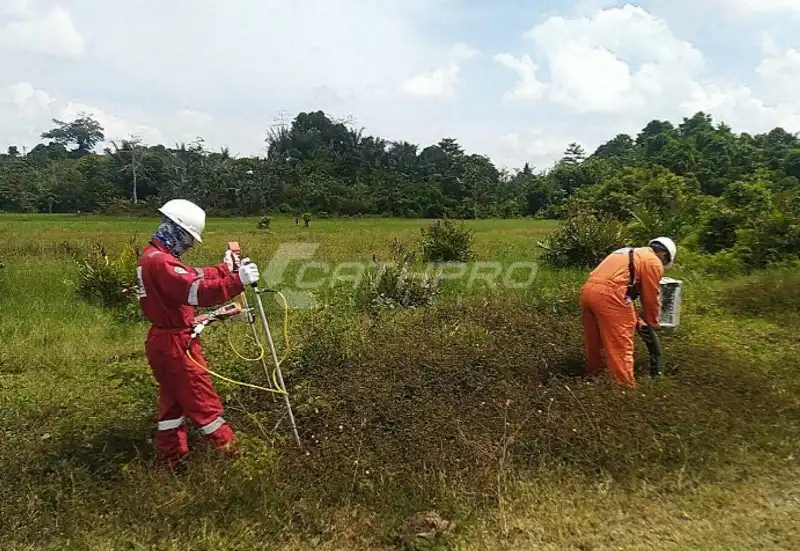
What is & Direct Current Voltage Gradient (DCVG)?
The operation of Direct Current Voltage Gradient (DCVG) involves applying direct current (DC) to the outer surface of underground pipes or metal structures in soil or water environments. The main goal of DCVG is to detect and identify potential corrosion on the pipes. Here are the general steps in how DCVG works:
- Application of Direct Current (DC): Direct current, originating from an external power source, is applied to the pipe’s surface using electrodes or pulse stations.
- Current Distribution: The current flowing through the pipe will distribute itself along the surface of the pipe and propagate into the surrounding area.
- Voltage Gradient: Voltage gradient is the change in electric potential along the pipe’s surface. The voltage gradient is measured using reference electrodes or earth references.
- Monitoring and Data Recording: While the direct current is applied, the DCVG system monitors and records the distribution of the voltage gradient on the pipe. Changes in the voltage gradient can indicate anomalies, such as corrosion or defects in the pipe coating.
- Interpretation of Data: The collected data is then interpreted to identify potential corrosion locations or areas that require further attention. Anomalies in the voltage distribution may indicate issues with the pipe, such as localized corrosion or areas with damaged coatings.
- Preventive or Corrective Actions: If an issue is detected, preventive or corrective actions can be taken according to the severity of the identified problem. This may involve cleaning, recoating, or other maintenance measures.
It’s important to note that DCVG is just one method in the category of electrochemical techniques used for inspecting and monitoring corrosion on underground pipes. This method assists pipeline operators in identifying potential problems before they escalate into more serious damage.
Why is CIS Important?
1. Evaluation of Cathodic Protection Performance:
- CIS helps check whether the cathodic protection system on metal pipes is functioning well or not.
2. Detection of Anomalies or System Weaknesses:
- This survey helps find issues or weaknesses in the cathodic protection system, aiding in identifying areas of corrosion that need fixing.
3. Continuous Monitoring:
- The CIS process allows continuous monitoring of metal pipes, helping detect changes that may affect cathodic protection.
4. Reducing Corrosion Risks:
- Through CIS, the risk of severe damage due to corrosion can be minimized, and maintenance can be performed before issues become serious.
5. Compliance with Standards and Regulations:
- Many regulations require routine cathodic protection surveys. CIS helps ensure compliance with these requirements.
6. Environmental Monitoring:
- Effective cathodic protection prevents leaks and environmental contamination due to corrosion on metal pipes.
7. Preventive Maintenance:
- Through CIS, companies can implement preventive maintenance by identifying and addressing issues before they become serious and costly to fix.
What We Offer?
- In-Depth Inspection: A comprehensive process to meticulously inspect every inch of the pipeline.
- Pipeline Mapping: Using mapping technology to track the position and structure of pipelines accurately.
- Cutting-Edge Solutions: Employing the latest technology and equipment for optimal results.
Benefits of CIS with Us:
- Early Detection: Identifying potential issues before they become serious.
- More Efficient Maintenance: Allowing for timely preventive maintenance.
Case Study: Overcoming Challenges with CIS
Successfully assisted organizations in preventing pipeline failures and improving maintenance efficiency.
Why Choose CIS Solutions?
- Expertise: A professional team with experience in executing CIS tasks and is registered and certified by NACE.
- Cutting-Edge Technology: Using the latest technology for accurate results.
- In-Depth Understanding: Understanding the complexity and unique needs of each pipeline system.
Contact Us Now for a Free Consultation!
PCM+: Advanced Solution for Detecting and Mapping Pipeline Corrosion
We present cutting-edge technology in locating and measuring corrosion on pipelines using electromagnetic detection devices (Locators). Now, this method is increasingly linked with Geographic Information Systems (GIS) and GPS information, providing accurate records of pipeline conditions, as well as position and time coordinates for post-inspection mapping analysis. This forms the foundation of PCM+.
Benefits of PCM+:
- Preventive Maintenance: PCM+ enables pipeline technicians to perform preventive maintenance, extending the life of pipelines, and identifying corrosion at an early stage.
- Portable and Handheld: The system consists of a portable transmitter and a handheld receiver. The transmitter, connected at the CPS station or test post, applies a special signal to the pipeline.
- Accurate Mapping: The receiver locates this unique signal at distances up to 30 km, identifying the position and depth of the pipe. Technicians can map leakage currents along the pipeline for a quick identification of coating defects.
- Precision Detection: Using an A-frame, the position and depth of defects can be further pinpointed within a 1-meter range, ensuring precision detection.
- Advanced Features of PCM+: PCM+ is equipped with reliable features such as Automatic Signal Attenuation (ASA), enabling detection and mapping of pipelines even in areas with interference or metal density.
Simultaneous Measurements: PCM+ provides simultaneous measurements of PCM current (ACCA) and Voltage Gradient (ACVG), eliminating the need for operators to perform ‘current spans’ and manual calculations.
Make PCM+ your trusted partner in maintaining the integrity and reliability of pipeline systems. With our cutting-edge technology, you can quickly identify potential issues and take necessary preventive actions. Achieve longer pipeline lifespans and protect the environment with PCM+.